Behave to stay together
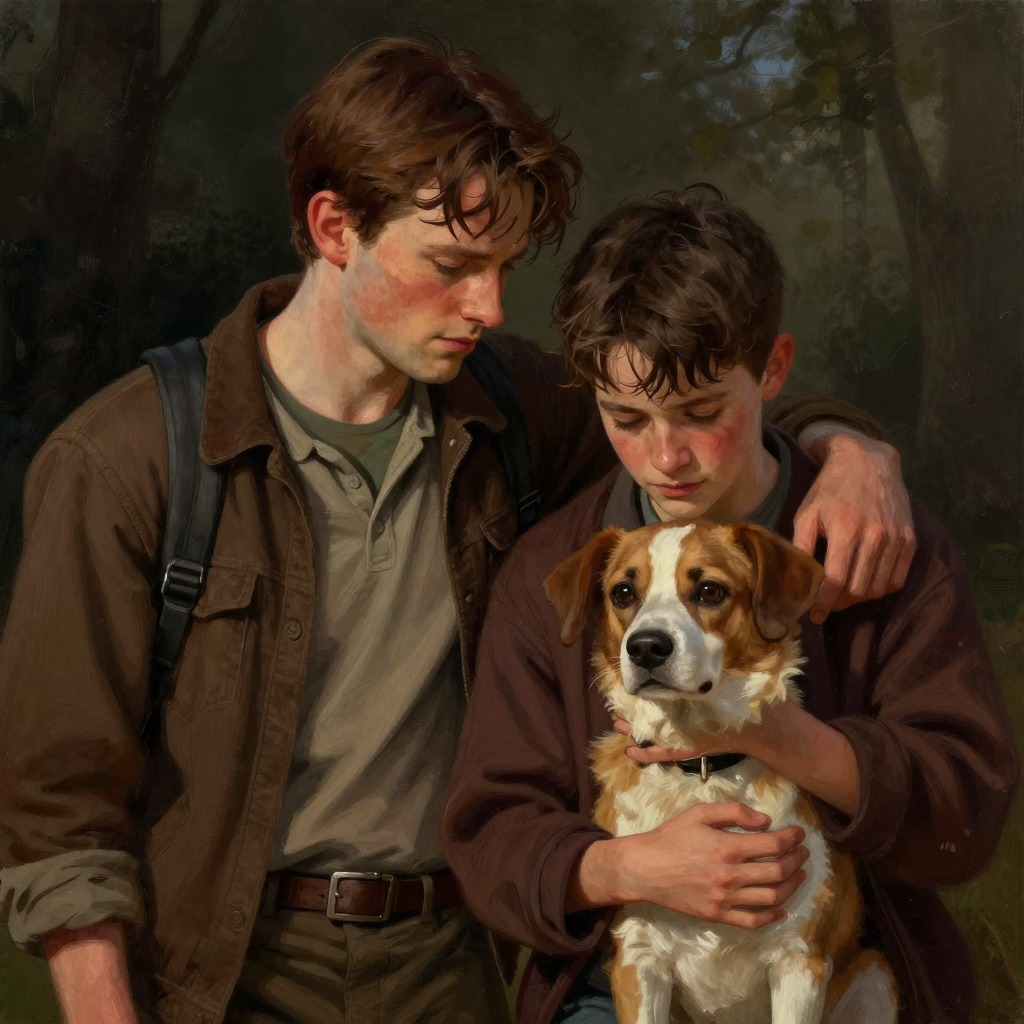
After the death of their parents in an auto wreck, the three Curtis brothers—Darrel, Sodapop, and Ponyboy—are allowed to remain together only as long as they behave. This condition is the foundational rule of their household, a legal and social ultimatum that shapes every major decision the brothers make. Ponyboy explains the rule explicitly: "Since Mom and Dad were killed in an auto wreck, the three of us get to stay together only as long as we behave. So Soda and I stay out of trouble as much as we can, and we're careful not to get caught when we can't." The rule is not a formal court order but a known consequence of their situation as minors without parents, enforced by the threat of the state stepping in. It creates a constant, underlying pressure that distinguishes their family from a traditional one, where misbehavior might bring a scolding but not the risk of permanent separation.
The Rule's Enforcement and Daily Life
The rule manifests most directly in Darrel's strict, often harsh parenting style. Darrel, who works long hours roofing houses and holds down two jobs, is acutely aware that any serious trouble involving Ponyboy or Sodapop could trigger a review of his guardianship. This fear drives his constant nagging and yelling. When Ponyboy is late coming home after falling asleep in the vacant lot, Darrel's fury is not just about the lateness but about the potential consequences: "I reckon it never occurred to you that your brothers might be worrying their heads off and afraid to call the police because something like that could get you two thrown in a boys' home so quick it'd make your head spin." The rule thus transforms ordinary teenage mistakes into existential threats. Ponyboy resents this pressure, feeling that Darrel "would have hollered at me for carrying a blade if I had carried one" and that he can never please him. Yet the rule also provides a framework for the brothers' survival, forcing them to prioritize their family unit above individual desires.
The Rule's Role in the Gang's Social Structure
The "behave to stay together" rule is a specific instance of the broader greaser code of "stick together," which applies to the entire gang. The gang functions as a surrogate family for boys like Johnny Cade, whose parents beat and ignore him, and for whom the gang provides the only love and affection he knows. The rule of mutual loyalty is absolute: "You take up for your buddies, no matter what they do. When you're a gang, you stick up for the members. If you don't stick up for them, stick together, make like brothers, it isn't a gang any more." This code extends to practical support—the gang's front door is always unlocked for any member who needs a place to stay—and to collective responsibility in fights. The rule against getting caught is a corollary: "Our one rule, besides Stick together, is Don't get caught." This pragmatic rule acknowledges that the greasers are already targets of the police and the Socs, and that getting caught only makes their precarious situation worse.
The Rule's Ultimate Test and Transformation
The rule is tested to its breaking point when Johnny kills Bob Sheldon in self-defense and Ponyboy runs away with him. The murder and flight directly violate the condition of staying out of serious trouble, and Ponyboy immediately fears the consequence: "If Johnny got caught, they'd give him the electric chair, and if they caught me, I'd be sent to a reformatory." The rule, which had been a source of tension between Darrel and Ponyboy, becomes the very thing that drives them apart. Yet the rule also motivates their eventual return. Johnny decides to turn himself in partly because "it ain't fair for Ponyboy to have to stay up in that church with Darry and Soda worryin' about him all the time." The desire to preserve the family unit, even at the cost of facing punishment, shows how the rule has been internalized as a value. After the hearing, when the judge acquits Ponyboy and the family is allowed to stay together, the rule is reaffirmed but transformed. The brothers' final reconciliation comes when they recognize that their bond is more important than any external threat: "We're all we've got left. We ought to be able to stick together against everything. If we don't have each other, we don't have anything." The rule evolves from a condition imposed by the state into a freely chosen commitment to one another.